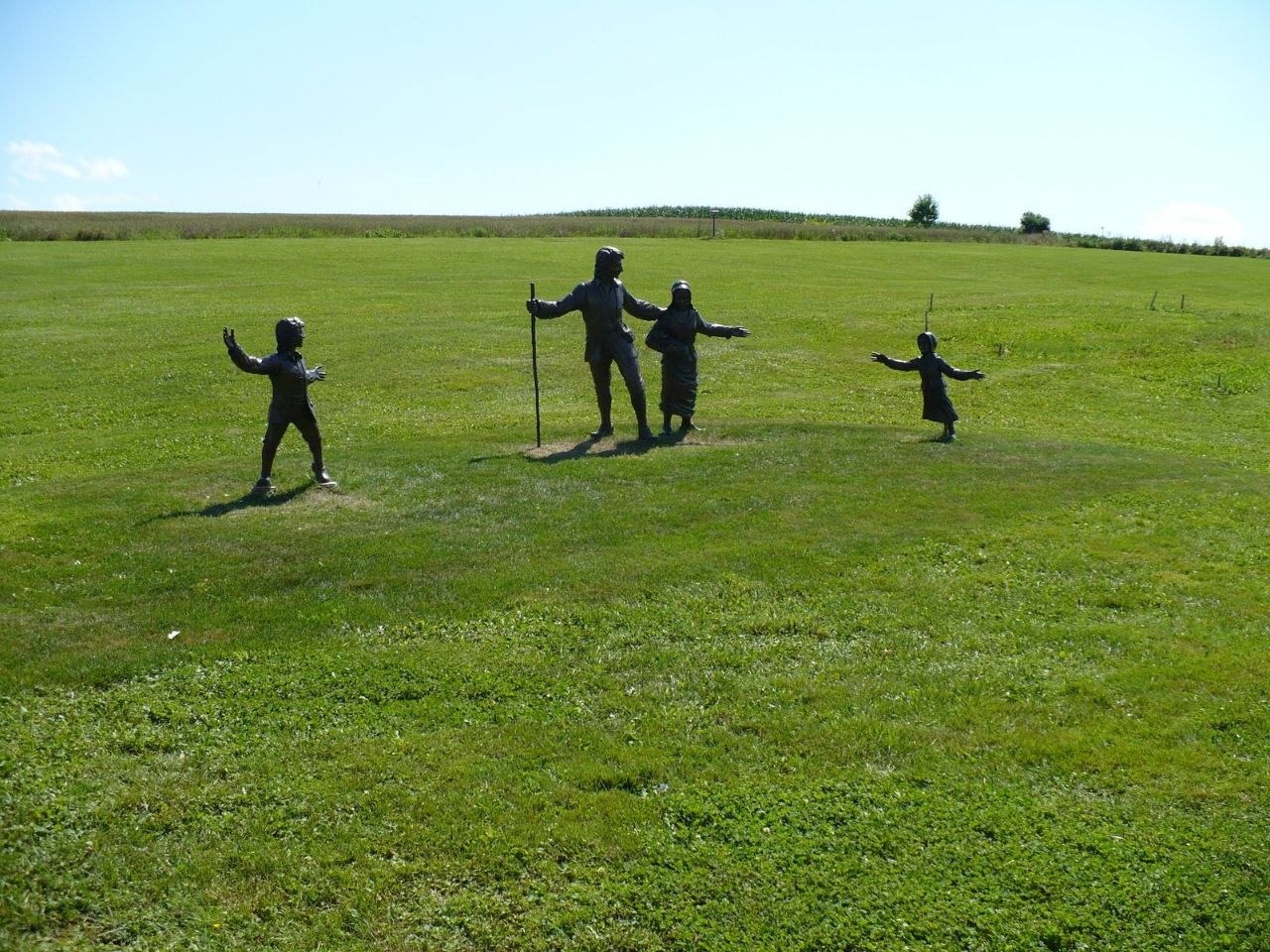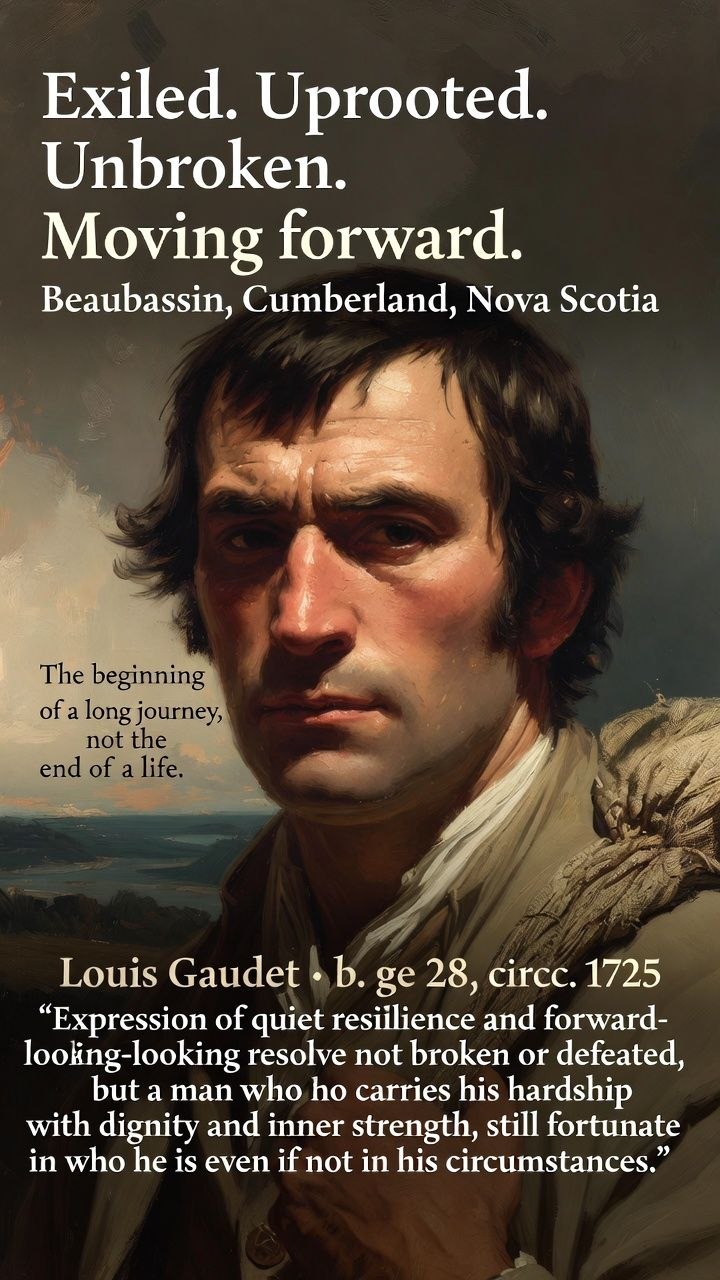
Louis Gaudet · b. c. 1727 · Beaubassin, Acadia
They were deported, separated at gunpoint, and forced apart with no chance to say goodbye. Louis traveled over a thousand miles through hostile wilderness to find his wife. They survived a winter eating bark and hides. They were captured and held as prisoners of war. They were exiled across the Atlantic — twice. And in the end, they died completely free, surrounded by their children and grandchildren on land they owned along the bayous of Louisiana.
This is Generation V of the Rob Gaudet line — the most extraordinary chapter in 450 years of family history. One of the most thoroughly documented Acadian survival stories on record, tracked across the archives of three nations.
✦ Their Place in the Gaudet Line
Louis Gaudet (b. c. 1727) is Generation V in the direct line from Jean Gaudet — the patriarch who arrived in Acadia in 1636. Louis and Marie's son, François Louis Gaudet, born during their exile in Nantes, France, carried the family name to Louisiana. François Louis is Generation VI — and every Gaudet in Louisiana today descends from this extraordinary couple's will to survive.
Louis Gaudet was born around 1727 in Beaubassin, Acadia — a direct descendant of Jehan Gaudet, who had crossed the Atlantic from France more than a century before. Marie Hébert was born around 1730, the daughter of a prominent local farming family. By the early 1750s, the young couple had married and settled in Tintamarre, a bustling agricultural community on the Chignecto Isthmus near what is now the Nova Scotia–New Brunswick border.
Like generations before them, Louis and Marie were master agriculturalists — engineers of the wetlands. They spent their days constructing aboteaux: complex wooden dike systems fitted with one-way sluice gates that blocked the massive Atlantic tides, draining the salt marshes and creating some of the most fertile farmland in North America. This was not subsistence living. This was abundance, built by hand from the sea itself.
In the 1752 French Census of Tintamarre, Louis and Marie are recorded as young, established settlers — not refugees, not struggling newcomers, but a growing household with a home, livestock, and a prosperous future ahead of them. They had built something real. They had no idea that empires were about to collide on their doorstep.
The Chignecto region was targeted with calculated efficiency. British soldiers lured the Acadian men into local forts under the pretense of an official announcement — then locked the doors behind them. Louis Gaudet was among those arrested. He was separated from his wife and children with no opportunity to say goodbye, marched to the shore under armed guard, and forced into the cramped, dark hold of the British brigantine Two Brothers. The ship set sail south, eventually depositing Louis as a penniless, hostile refugee in South Carolina.
Behind him, smoke filled the sky. British troops systematically burned every Acadian home, barn, and church to ensure the families had nothing to return to. Left alone with her children, facing starvation or capture, Marie Hébert gathered her young children and fled into the dense northern forests.
"Terrified, freezing, and hunted by British patrols, the refugees resorted to eating hides, carrion, and tree bark. Hundreds died. Marie kept her children alive through sheer force of will."
Marie joined a desperate exodus of thousands of escaping Acadians moving north toward New Brunswick. They eventually established Camp Espérance — Hope Camp — along the Miramichi River. The winter of 1756–1757 was a waking nightmare. The camp was a barely-functioning refugee settlement, hunted by British patrols, slowly starving. Hundreds of Acadians died of starvation and exposure that winter. Marie was not among them. Neither were her children.
In 18th-century America, traveling over a thousand miles through hostile British territory, trackless wilderness, and coastal waters back to Canada was not a plan. It was a death wish. Yet Louis — either by escape or negotiated release — made exactly that journey. He navigated the Atlantic frontier and the dense northern woods with a singular, consuming purpose: find his family.
Against all mathematical and human probability, he succeeded. Louis made it back to the Canadian wilderness and miraculously reunited with Marie and the children hiding in the forests near Camp Espérance.
Their joy was short-lived. For the next several years, the Gaudet family lived as fugitives — moving constantly from hideout to hideout, fleeing further north toward Restigouche as the British military relentlessly hunted the remaining Acadian resistance. Around 1761, British forces finally captured them. Louis, Marie, and their children were marched back to Chignecto — the very land they once owned — and held as prisoners of war at Fort Cumberland (the renamed Fort Beauséjour) until the Treaty of Paris in 1763 officially ended the war and forced their release.
Their first stop was the tiny, rocky French-controlled islands of Saint Pierre and Miquelon off Newfoundland. They fished the cold waters, but the islands quickly became dangerously overcrowded with destitute Acadian refugees, triggering a severe famine.
In the autumn of 1767, French and British authorities decided to clear the islands. Once again, Louis and Marie were forced onto a ship — the French vessel La Félicité. On November 9, 1767, the ship arrived at the historic port of La Rochelle, France.
For nearly twenty years, Louis and Marie lived as impoverished exiles in a France their ancestors had left four generations before. The French government moved them around: in 1773, they participated in an ill-fated agricultural colony in Poitou (Châtellerault) before eventually settling in the bustling port city of Nantes.
It was during these difficult years of displacement that their son, François Louis Gaudet, was born — around 1773–1777. He was French by birthplace, Acadian by blood, and Louisiana by destiny. Though the family was safely among French speakers, they were strangers in a European world, always longing for the independent, pastoral life they had lost, always looking west.
In September 1784, Louis and Marie signed their names to a manifest in Nantes, declaring their formal desire to go to Louisiana at the expense of His Spanish Majesty. After thirty years of being pushed across the Atlantic world by forces beyond their control, they were finally choosing their own destination.
On December 17, 1785, after nearly eighty days on the Atlantic Ocean, the ship La Caroline arrived at the port of New Orleans. Listed as the 4th family on the passenger manifest was Louis Gaudet — now a veteran survivor in his late 50s, listed as a fisherman and laborer — his faithful wife Marie Hébert, and their children, including young 12-year-old François Louis.
They had crossed the Atlantic twice. They had survived a wilderness winter, a thousand-mile escape on foot, years as prisoners of war, exile in a European city, and eighty days at sea. They had lost everything — their farm, their home, their country — and found each other again across impossible distances.
"Listed as the 4th family aboard La Caroline. After thirty years and two ocean crossings, they had finally arrived at a place they could call home."
— The Seven Ships Passenger Records, 1785Once again, Louis and Marie cleared the land, tamed the water, and built a homestead. Spanish colonial census records from January 1788 show them successfully settled and farming along the bayou — just three years after their arrival. The same hands that had built aboteaux in Tintamarre were now coaxing crops from the rich Louisiana alluvial soil.
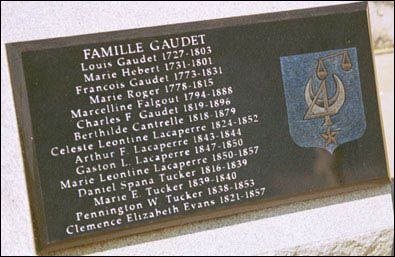
Marie Hébert passed away around 1801. Louis Gaudet followed her in 1803. His plaque still stands at St. Joseph's Cemetery in Thibodaux — a stone marker for a man who crossed an ocean twice and never stopped moving until he found home.
After thirty years of being hunted, separated, imprisoned, and exiled across the globe, they died completely free, surrounded by their children and grandchildren, on land they owned. Their son François Louis grew up to marry into the local community, ensuring the Gaudet name was permanently woven into the fabric of Louisiana — and every Gaudet in the bayou parishes since traces back to this couple's refusal to be erased.
The odyssey of Louis Gaudet and Marie Hébert is one of the most thoroughly verified genealogies in Acadian history — tracked across the archives of three nations.