A Living Legacy · 1575 – Present

The Rob Gaudet Line

From the Fields of Acadia to the Bayous of Southern Louisiana

Fourteen generations of one family — from the Abraham of all Acadian and Cajun people, through deportation, exile, and rebirth in Louisiana, to the present day.

This is my particular lineage — the direct line from Jean Gaudet to me, Rob Gaudet, and my son Robert Jordan. If you carry the Gaudet name or have Gaudet ancestry, you share Jean as your patriarch too. Somewhere along this line — or in one of the hundreds of branches that split off across Acadia, Louisiana, and beyond — your family and mine were one.

✦ A Note on the Portraits

The portraits on this page were created using artificial intelligence. For the generations without surviving photographs, AI image generation was used to bring each ancestor to life in the artistic style of their era — oil painting, daguerreotype, wet plate photograph, and so on.

The faces were not invented at random. Using real photographs of Robert Keith Gaudet (Generation XIII), his son Robert Jordan Gaudet (Generation XIV), his father Robert William Gaudet and Robert William's brother, and his grandfather Oscar Richard Gaudet and Oscar's brothers — a composite facial profile of the Gaudet line was developed. That composite was used as the foundation for every AI-generated portrait, so each ancestor's face reflects the genuine inherited features of this family: the broad jaw, the deep-set eyes, the olive complexion, the quiet bearing.

These are not imagined faces. They are the face of the Gaudet line, carried backwards through time.

Generation I
I
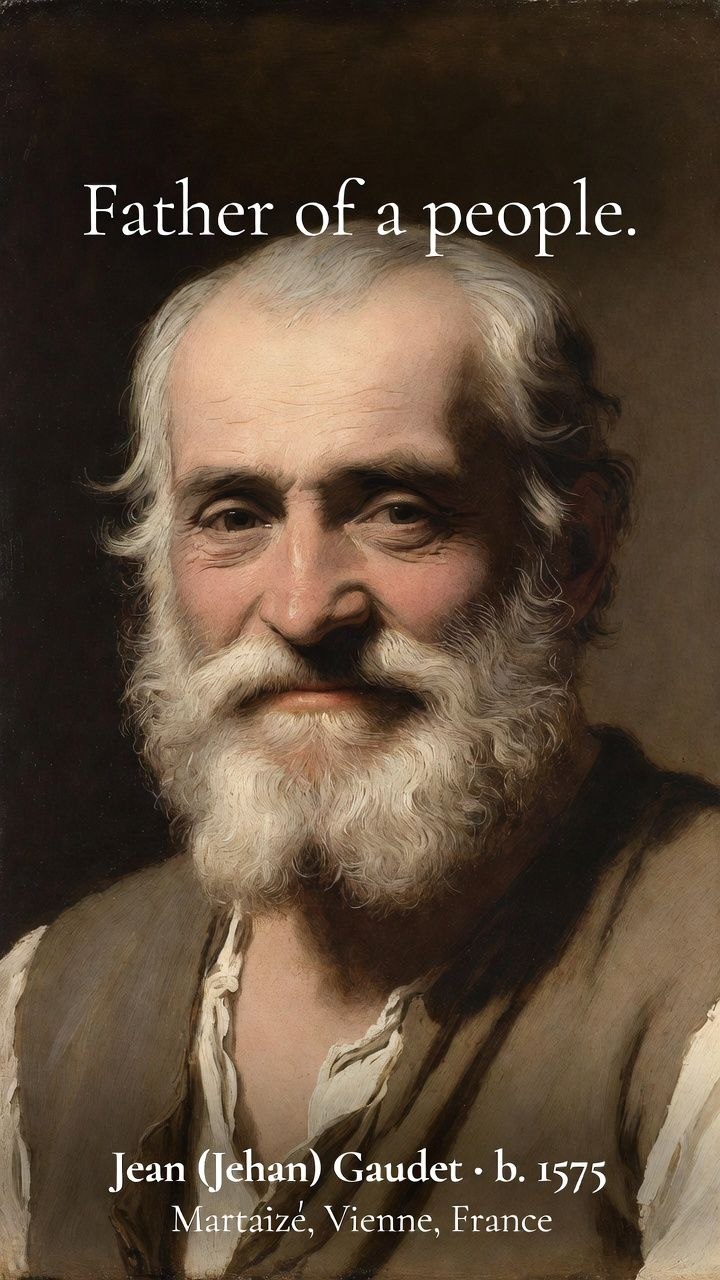
Jean Gaudet · b. 1575 · Martaizé, France
c. 1575
Father of a people
♛
Jean (Jehan) Gaudet
b. 1575 · Martaizé, Vienne, France
"Practically the Abraham of the Acadians, so numerous are his descendants."
— Historical Census Record, 1671
France in the early 1600s was a kingdom of peasant farmers, religious wars, and colonial ambition. Jean left a small village in the Loire Valley and crossed the Atlantic to build something new — arriving in Acadia when it was little more than a few dozen families clinging to the edge of a continent. He outlived a century, watching his children and grandchildren root themselves into marshland soil that would define a people.
The patriarch of the entire Gaudet lineage. Arrived in Acadia aboard the ship St.-Jehan in 1636 with three children. Lived past age 100 and is listed in the 1671 census as "the oldest inhabitant of Port Royal." He has over 234,000 known descendants — the most of any founding Acadian father.
AI Image Prompt
A dignified oil portrait painting of an elderly French farmer-settler, age 96, circa 1671. Broad squared jaw, strong prominent brow ridge, deep-set dark eyes, broad straight nose with a slightly rounded tip, olive-toned complexion. Long white beard, deeply weathered and lined face. Expression of deep contentment and quiet pride — a man who has lived a full and fortunate life, at peace with himself and the world he built. Warm, wise eyes with a hint of a smile. White hair thinning with age. Wearing rough homespun linen shirt and wool vest typical of 17th century French peasant settlers. Soft natural candlelight. Dark muted background. Painted in the style of a Flemish old master portrait. Realistic, historical, sepia and earth tones. Mood: "Father of a people." At the bottom of the image in a consistent serif font, include the caption: "Jean (Jehan) Gaudet · b. 1575 · Martaizé, Vienne, France"
⬇
Generation II
II
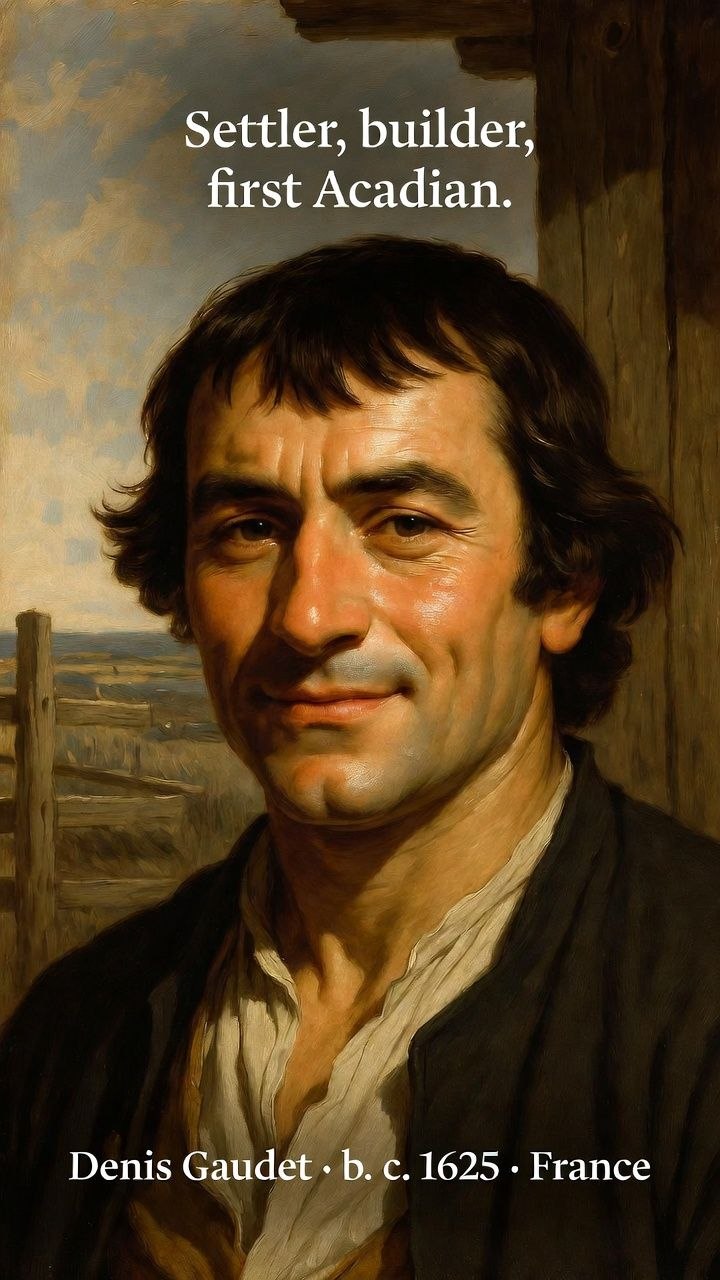
Denis Gaudet · b. c. 1625 · France
c. 1625
Settler, builder, first Acadian
Denis Gaudet
b. c. 1625 · France
Son of Jean · Born in France
Denis crossed the Atlantic as a child of eleven, trading the Loire Valley for the wild marshes of Nova Scotia. He grew up in one of the world's youngest colonies — Port Royal — where the Acadian identity was just beginning to take shape. Farming the tidal marshlands with the unique dyking system the Acadians perfected, Denis lived a long and prosperous settler's life.
Born in France before the family emigrated to Acadia. Denis was one of three children Jean brought to the New World in 1636. He grew up in the colony at Port Royal and married Martine Gauthier around 1645. He lived into his mid-eighties and died at Port Royal in October 1709.
AI Image Prompt
A realistic painted portrait of a middle-aged French-Acadian colonial man, circa 1670, age roughly 45. Broad squared jaw, heavy straight brow ridge, deep-set dark brown eyes, broad nose with a slightly rounded tip, olive complexion tanned from outdoor work. Dark brown hair worn long, full head of hair. Expression of quiet contentment and grounded confidence — a man comfortable in his own skin, settled and fortunate in the life he has made. Calm, open face with a composed half-smile. Wearing a plain linen shirt with a simple collar and dark wool coat, 17th century Acadian settler style. Standing near a wooden fence with a glimpse of the Nova Scotia marshland behind him. Oil painting style, warm earth tones, natural lighting. Mood: "Settler, builder, first Acadian." At the bottom of the image in a consistent serif font, include the caption: "Denis Gaudet · b. c. 1625 · France"
⬇
Generation III
III
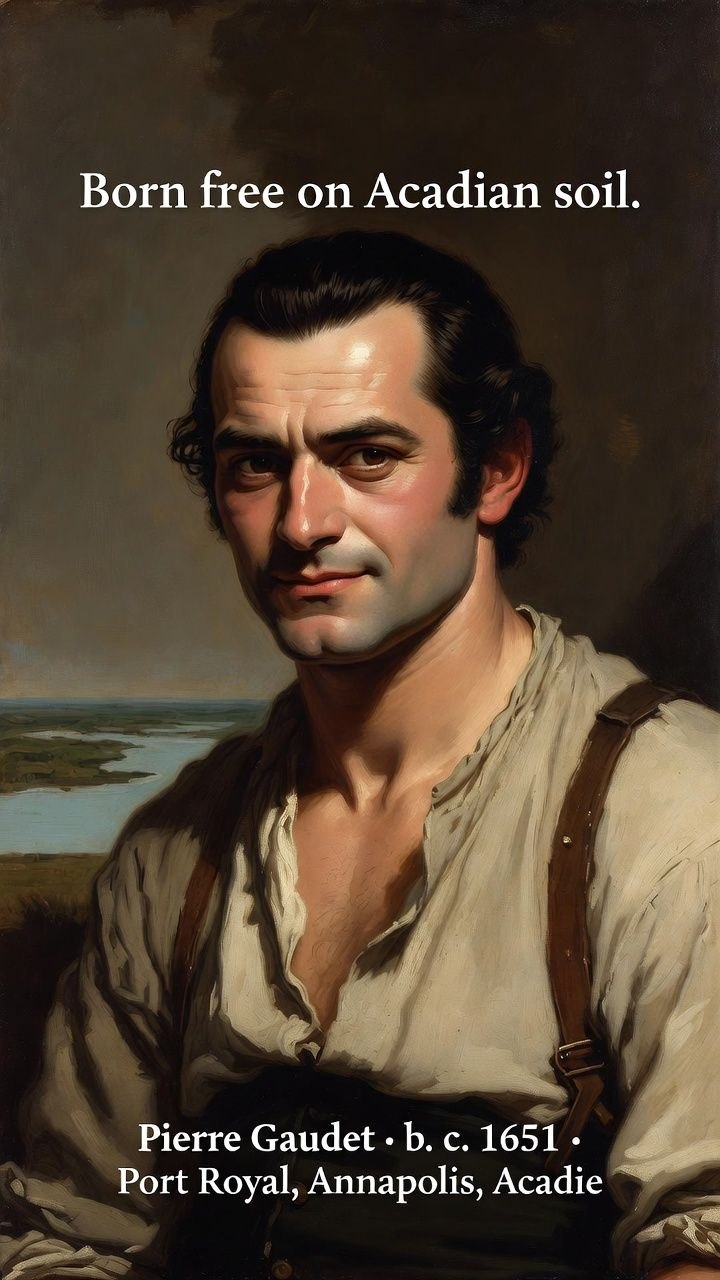
Pierre Gaudet · b. c. 1651 · Port Royal, Acadie
c. 1651
Born free on Acadian soil
Pierre Gaudet
b. c. 1651 · Port Royal, Annapolis, Acadie
First Generation Born in Acadia
Pierre was born into a community that had begun to thrive. The Acadians of Port Royal were developing their own distinct culture — French in language and faith, but uniquely shaped by the New World. They built dykes, raised cattle, traded furs, and largely kept the peace between French and British colonial powers through careful neutrality. Pierre's generation was the first that had never known France at all.
Born in the colony — the first of this line truly Acadian by birth. Grew up in Port Royal during a time of competing British and French colonial claims. Married Anne Blanchard and established his family on the fertile marshlands of Port Royal. His family appears in both the 1686 and 1693 Acadian censuses.
AI Image Prompt
A realistic oil painting portrait of a young Acadian colonial farmer, age 30, circa 1681, Port Royal Nova Scotia. Broad squared jaw, prominent straight brow ridge, deep-set dark brown eyes, broad nose with a slightly rounded tip, olive skin tanned from field work. Dark brown hair tied back, full head of hair. Solid broad-shouldered build. Expression of easy confidence and quiet pride — a young man who feels fortunate, rooted in his land and at ease with himself. Composed and content, with a relaxed natural posture. Wearing rough linen shirt, dark breeches, leather suspenders. Background shows the Annapolis Basin waterway and tidal marshlands in muted blue-green. 17th century New France colonial style portrait, warm candlelight, earthy palette. Mood: "Born free on Acadian soil." At the bottom of the image in a consistent serif font, include the caption: "Pierre Gaudet · b. c. 1651 · Port Royal, Annapolis, Acadie"
⬇
Generation IV
IV
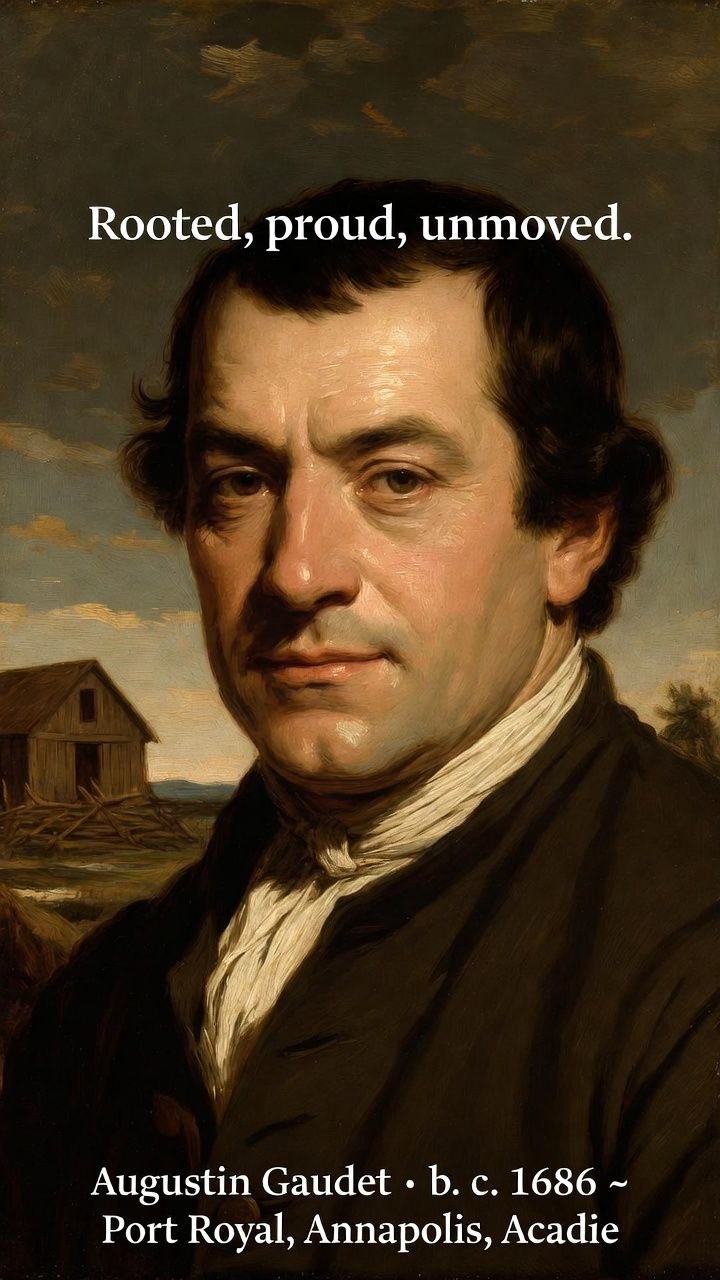
Augustin Gaudet · b. c. 1686 · Port Royal, Acadie
c. 1686
Rooted, proud, unmoved
Augustin Gaudet
b. c. 1686 · Port Royal, Annapolis, Acadie
Pre-Deportation Acadia
The Treaty of Utrecht in 1713 handed Acadia to Britain, but the Acadian people simply carried on. Augustin grew up in a community that had learned to endure political change with quiet stubbornness — refusing oaths, maintaining neutrality, speaking French, and tending their farms as they always had. It was a golden era on the surface, even as storm clouds gathered on the horizon.
Born into a generation that would live under growing British pressure. The Treaty of Utrecht in 1713 transferred Acadia to Britain, and Augustin's life would have been shaped by demands that Acadians swear oaths of allegiance to the British Crown — which many refused. He raised his family in the shadow of what was to come.
AI Image Prompt
Realistic painted portrait of an Acadian man, age 40, circa 1726. Broad squared jaw with a defined chin, heavy straight brow ridge, deep-set dark hazel eyes, broad nose with a slightly rounded tip, olive complexion weathered from outdoor farm work. Dark brown hair, full head of hair. Expression of strong-minded contentment — a man of conviction who is at peace with his place in the world, neither hardened nor troubled. Steady, warm eyes and a composed, self-assured bearing. Wearing early 18th century Acadian working clothes: linen shirt, dark wool waistcoat, simple cravat. Behind him, a dyked Acadian marshland farm with a wooden barn. Oil painting style, colonial portrait tradition, warm amber tones. Mood: "Rooted, proud, unmoved." At the bottom of the image in a consistent serif font, include the caption: "Augustin Gaudet · b. c. 1686 · Port Royal, Annapolis, Acadie"
⬇
Generation V
V
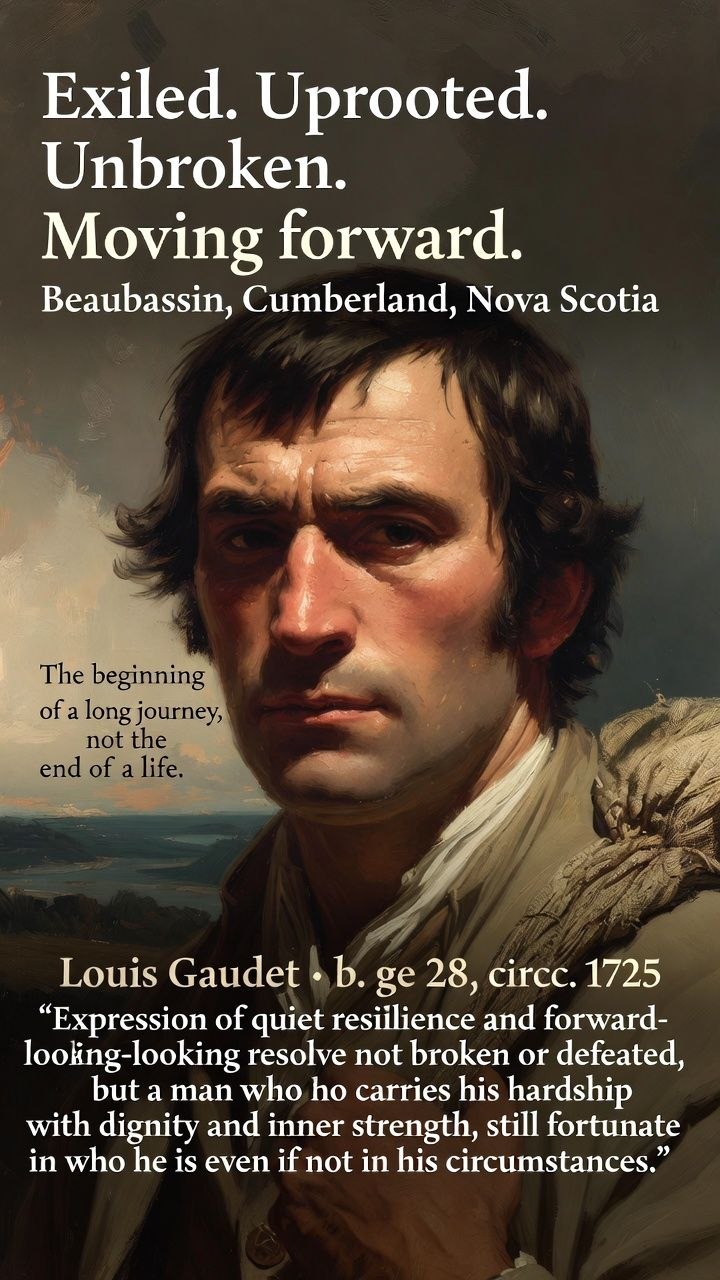
Louis Gaudet · b. c. 1727 · Beaubassin, Nova Scotia
c. 1727
Uprooted, unbroken, moving forward
Louis Gaudet
b. c. 1727 · Beaubassin, Cumberland, Nova Scotia
⚑ Deported to France · 1759
In 1755, British colonial authorities enacted one of the most sweeping forced removals in North American history — placing Acadian families on ships and scattering them across the Atlantic world. Farms were burned, families were split, and an entire way of life was torn apart. Louis was deported to France, a land his family had left four generations before. But the Acadians were not broken. They found each other again.
Louis Gaudet lived one of the most extraordinary lives in this entire lineage — a journey across three continents and as many countries. Born in Acadia (present-day Nova Scotia), uprooted by the British deportation of 1755, exiled to France, and finally landing in the bayous of Louisiana. Through every displacement, his wife Marie was by his side.

Records show Louis and his family listed on two of the seven ships that carried Acadian exiles from France to Louisiana. He made his final crossing in 1798 aboard the La Caroline — one of seven vessels that together carried hundreds of Acadian families from the port of France to their new home in Louisiana. The fact that he appears on two ships suggests he may have traveled with an advance group and returned — or more likely, stayed behind in France to help organize the passage for other families before finally boarding the last ship himself. It would be entirely in character.

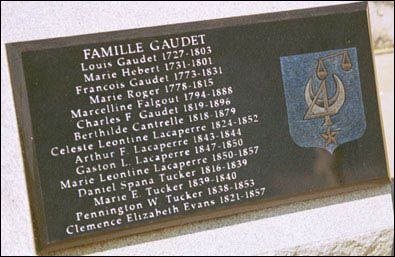
He arrived in Louisiana in 1798, settled near Bayou Lafourche, and lived until 1803. His plaque still stands at St. Joseph's Cemetery in Thibodaux — a stone marker for a man who crossed an ocean twice and never stopped moving until he found home.

🚢 The Seven Ships — Full Passenger Records →

Famille Gaudet historical monument plaque — Louis Gaudet 1727-1803

This historical monument plaque records the Famille Gaudet — with Louis Gaudet 1727–1803 listed first. This is a primary source confirmation of your Generation V ancestor, carved in stone.

Historical Monument Record · Famille Gaudet · St. Joseph's Cemetery, Thibodaux, Louisiana

AI Image Prompt
A realistic painted portrait of an Acadian man, age 28, circa 1755. Broad squared jaw, heavy straight brow ridge, deep-set dark eyes with a steady direct gaze, broad nose with a slightly rounded tip, olive complexion. Dark brown hair, full head of hair, slightly disheveled from the road. Broad-shouldered solid build. Expression of quiet resilience and forward-looking resolve — not broken or defeated, but a man who carries his hardship with dignity and inner strength, still fortunate in who he is even if not in his circumstances. Chin slightly raised, eyes clear and purposeful. Wearing simple 18th century Acadian clothing, a worn coat, with a bundled sack over one shoulder. Background shows a stormy sky with a distant shoreline — the beginning of a long journey, not the end of a life. Oil painting style, dramatic but warm lighting, muted palette. Mood: "Uprooted, unbroken, moving forward." At the bottom of the image in a consistent serif font, include the caption: "Louis Gaudet · b. c. 1727 · Beaubassin, Cumberland, Nova Scotia"
⬇
Generation VI
VI
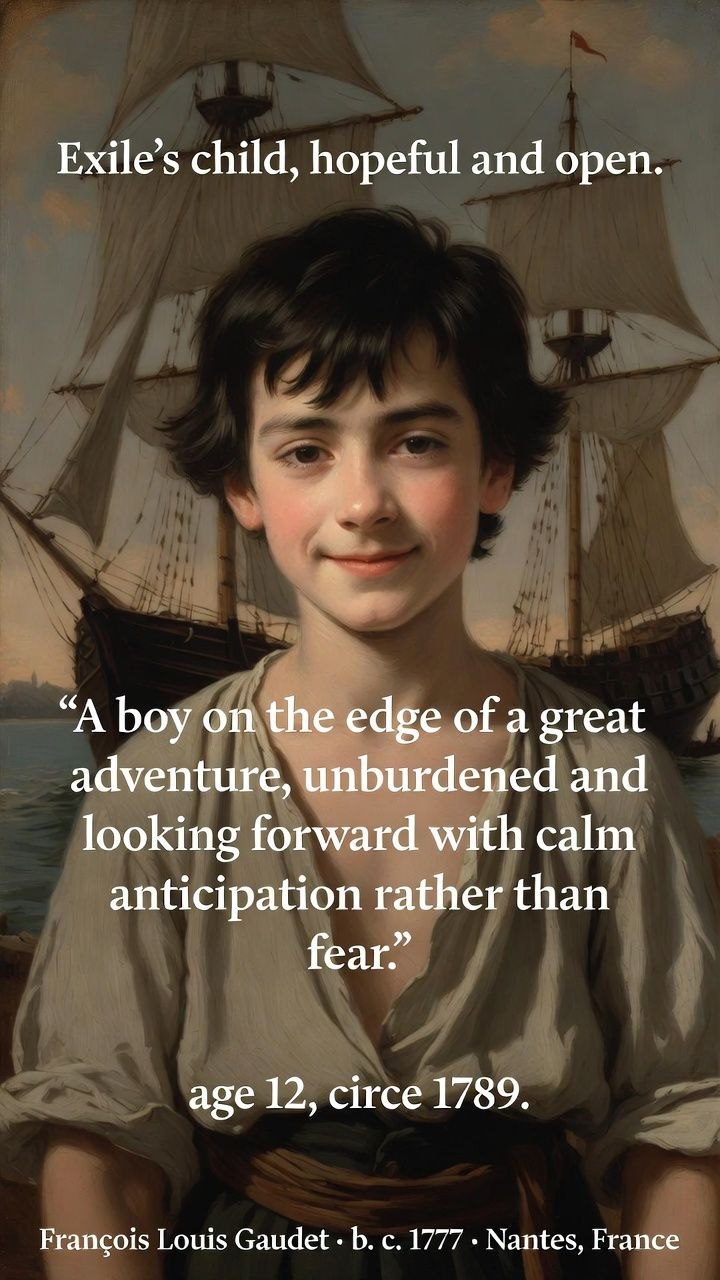
François Louis Gaudet · b. c. 1777 · Nantes, France
c. 1777
Exile's child, hopeful and open
François Louis Gaudet
b. c. 1777 · Nantes, France
Born in Exile · France
Nantes in 1777 was a city of shipbuilders, traders, and exiles — and among its streets lived hundreds of displaced Acadians waiting for their chance at a new life. François Louis was born into this in-between world: French by birthplace, Acadian by blood and story. He grew up as France itself tore apart in Revolution, and by the time he was twelve, his family had set sail once more — this time for Louisiana.
Born in Nantes, France during the family's exile — an Acadian by blood, but French by birth. He never knew Acadia. He grew up in a France roiling with Revolution, and by 1789 his family had joined the migration of exiled Acadians to Louisiana. François Louis would carry the Gaudet name to the New World a second time — this time to stay.
AI Image Prompt
Realistic portrait painting of a young French boy, age 12, circa 1789. Broad jaw beginning to take shape, dark thick brows, deep-set dark eyes, broad nose, olive complexion, dark brown hair slightly wavy — full head of hair. Expression of quiet curiosity and open-hearted hope — a boy on the edge of a great adventure, unburdened and looking forward with calm anticipation rather than fear. Bright, content eyes and a natural ease about him. Wearing simple late 18th century French working class clothes: linen shirt, dark breeches, worn leather shoes. Standing on a dock in Nantes, France with a sailing ship behind him — about to depart for Louisiana. Oil painting style, soft warm light, late 18th century palette. Mood: "Exile's child, hopeful and open." At the bottom of the image in a consistent serif font, include the caption: "François Louis Gaudet · b. c. 1777 · Nantes, France"
⬇
Generation VII
VII
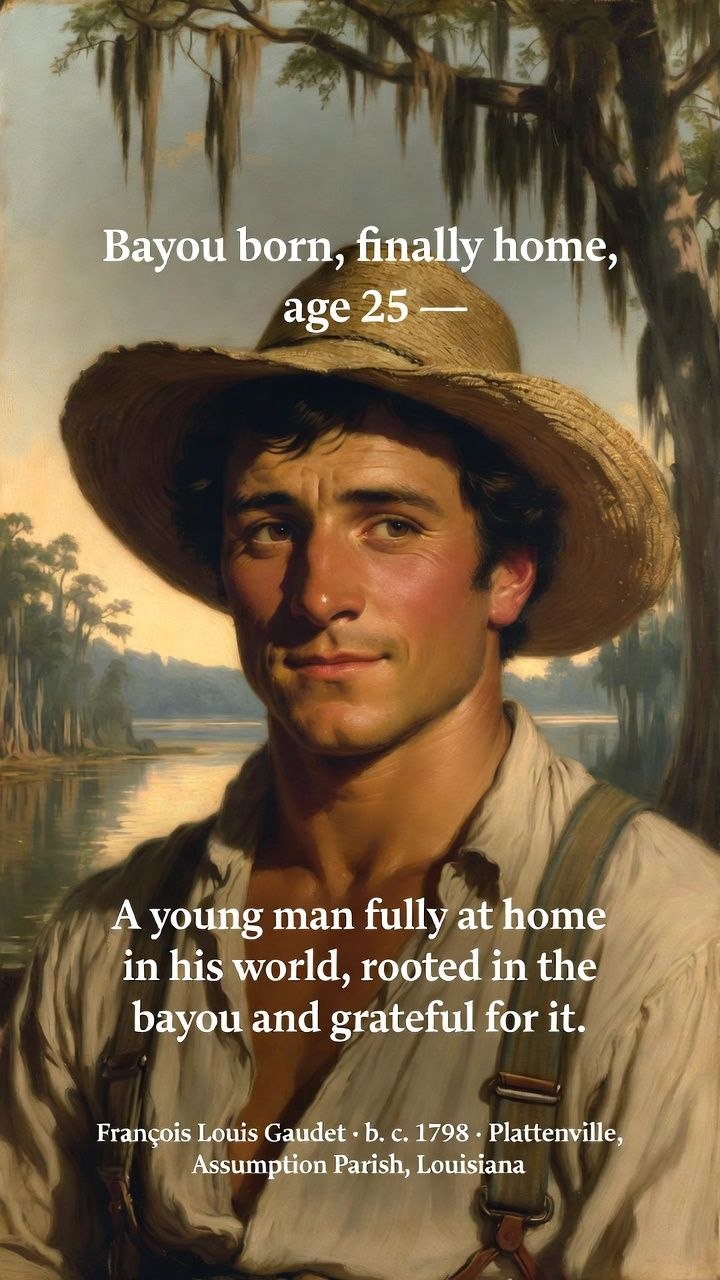
François Louis Gaudet · b. c. 1798 · Plattenville, Louisiana
c. 1798
Bayou born, finally home
François Louis Gaudet
b. c. 1798 · Plattenville, Assumption Parish, Louisiana
🌿 First Born in Louisiana
Plattenville sat on the banks of Bayou Lafourche in a Louisiana that was still being shaped — Spanish rule giving way to American, sugar cane replacing subsistence farming, and Acadian exiles putting down roots that would hold for centuries. The Cajun community here was tight, French-speaking, and fiercely its own. For François Louis, this was simply home — and it was a good one.
The first of the line born in Louisiana — a true Cajun by birth. Plattenville on Bayou Lafourche was a tight-knit Acadian community. The family had finally put down roots after generations of displacement. He grew up speaking French, working the bayou, and building a new version of the Acadian life his ancestors had lost.
AI Image Prompt
Realistic painted portrait of a young Cajun man, age 25, circa 1823, Assumption Parish Louisiana. Broad squared jaw, heavy straight brow ridge, deep-set dark hazel eyes, broad nose with a slightly rounded tip, olive sun-bronzed skin. Dark brown hair, full head of hair, slightly wavy. Solid broad-shouldered build. Expression of easy contentment and natural confidence — a young man fully at home in his world, rooted in the bayou and grateful for it. Relaxed posture, warm eyes, a quiet self-assured bearing without any edge or strain. Wearing early 19th century Louisiana working man clothes: linen shirt, suspenders, wide-brimmed straw hat. Background shows Bayou Lafourche with Spanish moss hanging from cypress trees. Warm golden light, American frontier portrait painting style. Mood: "Bayou born, finally home." At the bottom of the image in a consistent serif font, include the caption: "François Louis Gaudet · b. c. 1798 · Plattenville, Assumption Parish, Louisiana"
⬇
Generation VIII
VIII
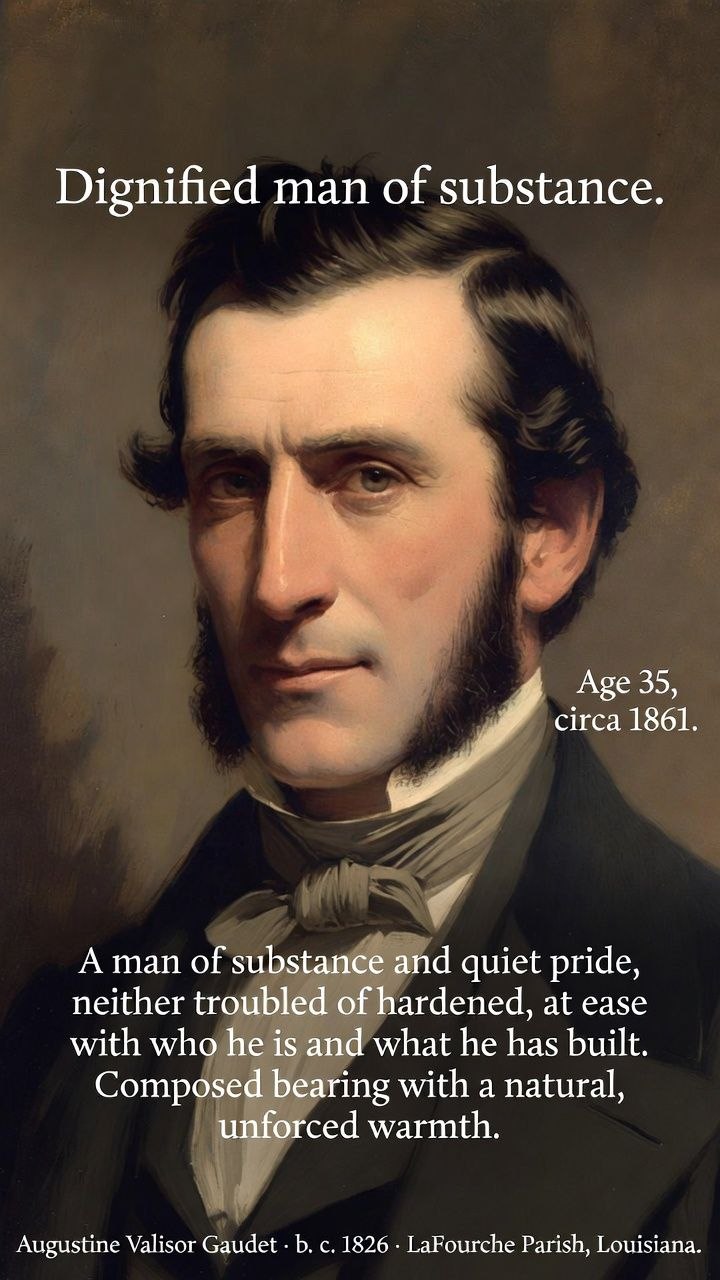
Augustine Valisor Gaudet · b. c. 1826 · LaFourche Parish, Louisiana
c. 1826
Dignified man of substance
Augustine Valisor Gaudet
b. c. 1826 · LaFourche Parish, Louisiana
Antebellum Louisiana
Lafourche Parish in the 1830s–60s was a world of sugar cane, steamboats, and French Catholic parishes where Cajun culture ran deep. Augustine Valisor came of age in antebellum Louisiana, a society balanced on the edge of enormous change. He would live through the Civil War — an upheaval that reshaped everything — yet the bayou life and the Gaudet family endured it all.
Born and raised in Lafourche Parish in the antebellum era, Augustine grew up in a Louisiana shaped by French Creole and Cajun culture, sugar cane plantations, and the complex society of the Deep South. His generation lived through the Civil War, which would transform Louisiana entirely.
AI Image Prompt
Realistic daguerreotype-style portrait of a Cajun man, age 35, circa 1861, Lafourche Parish Louisiana. Broad squared jaw with a defined chin, heavy straight brow ridge, deep-set dark brown eyes with a calm, steady gaze, broad nose with a slightly rounded tip, olive complexion. Dark brown hair, neatly combed, full head of hair. Neatly trimmed dark beard. Solid broad-shouldered frame. Expression of dignified contentment — a man of substance and quiet pride, neither troubled nor hardened, at ease with who he is and what he has built. Composed bearing with a natural, unforced warmth. Wearing mid-19th century working man Sunday clothes: dark frock coat, white shirt, simple cravat. Seated pose. Sepia photographic portrait style, simulating an 1860s daguerreotype, vignette edges, warm brown tones. Mood: "Dignified man of substance." At the bottom of the image in a consistent serif font, include the caption: "Augustine Valisor Gaudet · b. c. 1826 · LaFourche Parish, Louisiana"
⬇
Generation IX
IX
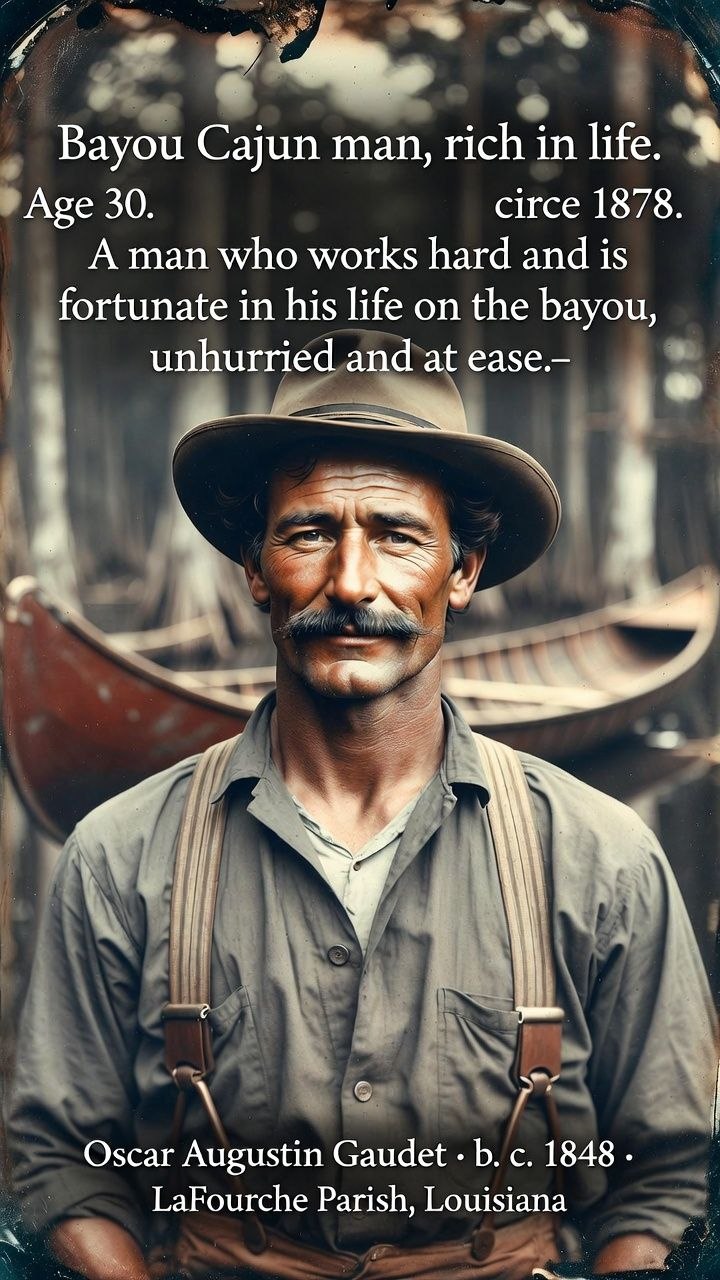
Oscar Augustin Gaudet · b. c. 1848 · LaFourche Parish, Louisiana
c. 1848
Bayou man, rich in life
Oscar Augustin Gaudet
b. c. 1848 · LaFourche Parish, Louisiana
Post-Civil War Louisiana
Reconstruction Louisiana was a time of upheaval, poverty, and grinding change — but the Cajun parishes along the bayous largely kept their own rhythms. Men like Oscar Augustin fished, trapped, farmed, and raised their families in French, largely outside the reach of the English-speaking world pressing in from all sides. It was a hardscrabble life, but it was theirs — and it was rich in ways no census could count.
Born just before the Civil War, Oscar Augustin grew up in its turbulent aftermath. Reconstruction Louisiana was a time of hardship, poverty, and resilience for Cajun families. Life in the bayou parishes meant fishing, trapping, farming, and holding tightly to the French language and culture that defined their identity.
AI Image Prompt
Realistic vintage photograph portrait of a Cajun man, age 30, circa 1878, Louisiana. Broad squared jaw, heavy straight brow ridge, deep-set dark eyes, broad nose with a slightly rounded tip, olive complexion weathered from bayou life. Dark brown hair and mustache, full head of hair. Solid broad-shouldered build. Expression of relaxed contentment and understated pride — a man who works hard and is fortunate in his life on the bayou, unhurried and at ease. Calm, open expression with steady eyes and a natural composure. Wearing a simple 1870s work shirt, suspenders, and a wide-brimmed hat. Standing beside a pirogue canoe on the edge of a Louisiana bayou with cypress trees. Style of a late 19th century wet plate collodion photograph, slightly faded, black and white with warm silver tones. Mood: "Bayou man, rich in life." At the bottom of the image in a consistent serif font, include the caption: "Oscar Augustin Gaudet · b. c. 1848 · LaFourche Parish, Louisiana"
⬇
Generation X
X
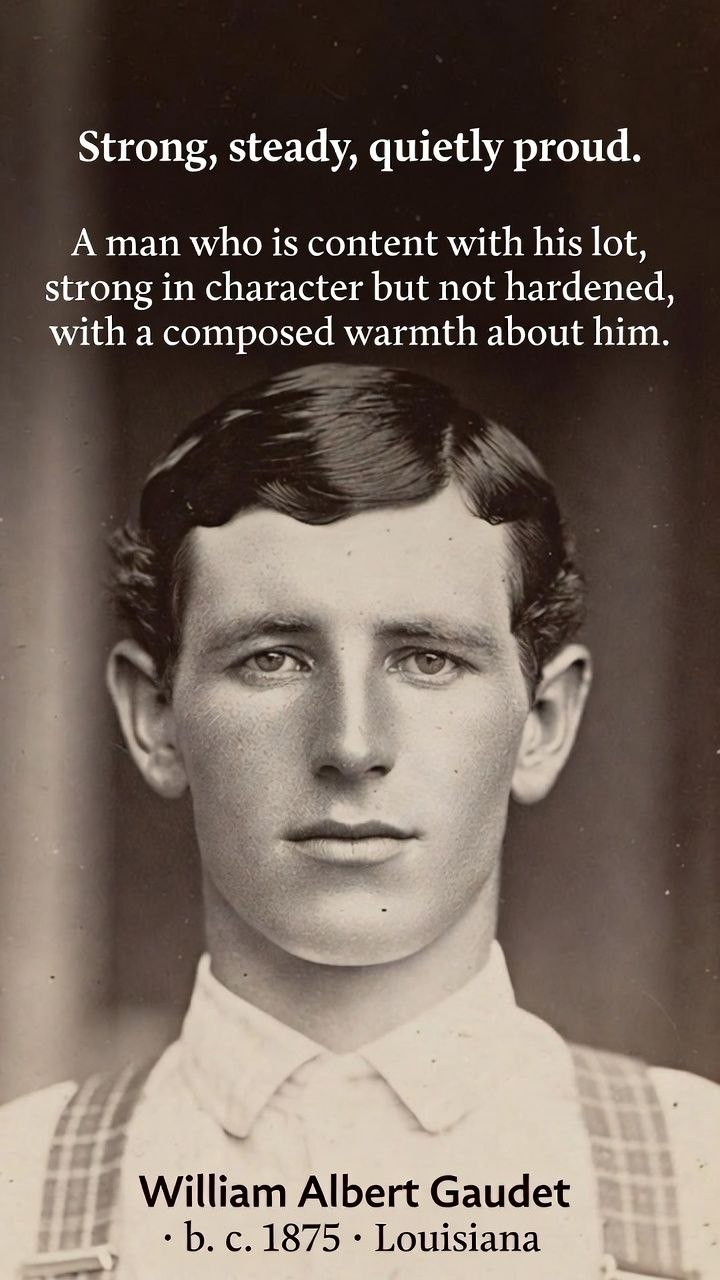
William Albert Gaudet · b. c. 1875 · Louisiana
c. 1875
Strong, steady, quietly proud
William Albert Gaudet
b. c. 1875 · Louisiana
Turn of the Century
The Gilded Age brought railroads, oil, and the wider American economy pushing into the bayou parishes. Cajun French was still spoken at home and in church, the pirogue still worked the marsh, and families like the Gaudets held tightly to their way of life even as the world around them modernized. William Albert's generation stood at the threshold of the 20th century — one foot in the old world, one in the new.
William Albert came of age in the Gilded Age. Louisiana's bayou parishes were changing rapidly with the arrival of the railroad and early oil industry. Cajun culture persisted stubbornly — French was still spoken at home, the pirogue still worked the marshes, and the Gaudet name endured.
AI Image Prompt
Realistic sepia toned photograph portrait of a Cajun man, age 28, circa 1903, Louisiana. Broad squared jaw with a defined chin, heavy straight brow ridge, deep-set dark eyes with a warm, confident gaze, broad nose with a slightly rounded tip, olive complexion. Dark brown hair neatly parted on the side, full head of hair, clean-shaven. Broad-shouldered solid build. Expression of quiet satisfaction and natural self-assurance — a man who is content with his lot, strong in character but not hardened, with a composed warmth about him. Wearing a simple early 1900s dress shirt with no collar, suspenders. Background is a rural Louisiana front porch. Style of an early 20th century cabinet card portrait photograph. Sepia tones, formal but warm. Mood: "Strong, steady, quietly proud." At the bottom of the image in a consistent serif font, include the caption: "William Albert Gaudet · b. c. 1875 · Louisiana"
⬇
Generation XI
XI
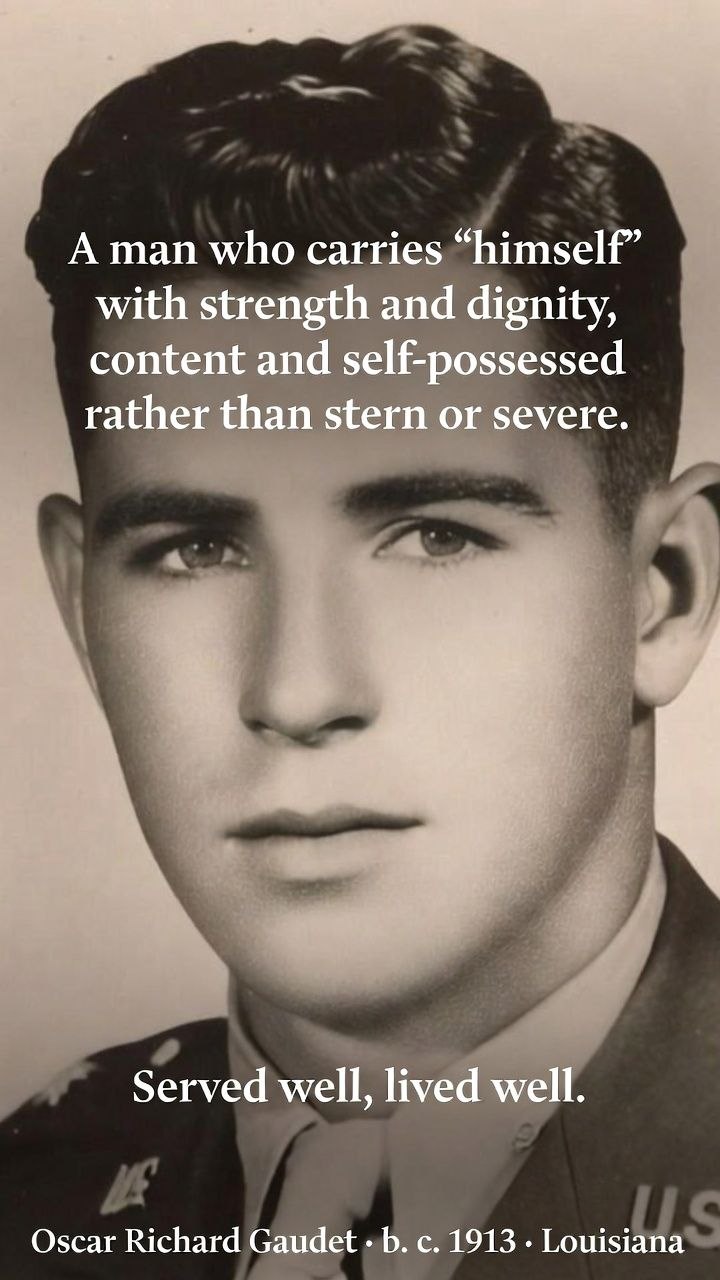
Oscar Richard Gaudet · b. c. 1913 · Louisiana
c. 1913
Served well, lived well
Oscar Richard Gaudet
b. c. 1913 · Louisiana
Your Grandfather
Oscar Richard's Louisiana was one of contradictions — Cajun French banned in schools, yet spoken defiantly at home; oil money changing the bayou, yet the old ways enduring. He served his country as a Marine, came home, and raised his family in the same parishes his ancestors had worked for a century and a half. His generation absorbed every blow the 20th century dealt and came out the other side still unmistakably Gaudet.
Your grandfather — born just before World War I and living through the Great Depression, World War II, and the transformation of Louisiana by the oil boom. His generation saw Cajun French suppressed in schools and public life. Yet the culture survived. He carried the Gaudet name — and the blood of Jean Gaudet himself — into the modern era.
AI Image Prompt
Realistic black and white military studio portrait of a young Cajun man, age 30, circa 1943, Louisiana. Broad squared jaw, heavy straight brow ridge, deep-set dark eyes with a warm steady gaze, broad nose with a slightly rounded tip, olive complexion. Dark hair cut short and neatly combed — full head of hair, no balding. Solid broad-shouldered build. Expression of quiet pride and easy confidence — a man who carries himself with strength and dignity, content and self-possessed rather than stern or severe. A composed, natural half-smile that suggests someone at peace with who he is. Wearing a U.S. Marine Corps uniform with collar insignia. Style of a 1940s formal military portrait photograph, high contrast black and white, warm paper tones. Mood: "Served well, lived well." At the bottom of the image in a consistent serif font, include the caption: "Oscar Richard Gaudet · b. c. 1913 · Louisiana"
⬇
Generation XII
XII
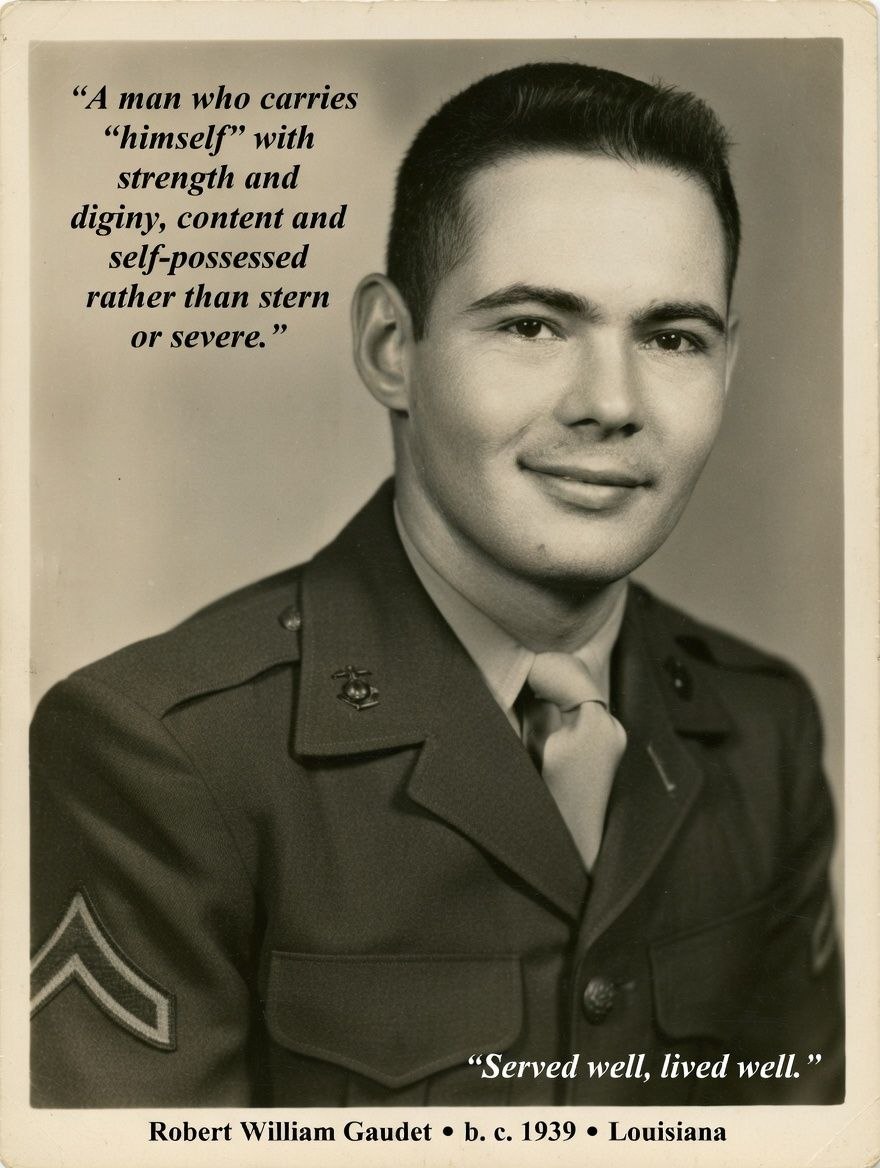
Robert William Gaudet · b. c. 1939 · Louisiana
c. 1939
Good-natured, easy in himself
Robert William Gaudet
b. c. 1939 · Louisiana
Your Father
Robert William grew up in postwar Louisiana — a time when the oil patch was king, civil rights were reshaping the South, and a quiet cultural revival was beginning to reclaim what had been suppressed for decades. The Cajun Renaissance of the 1960s and 70s saw French music, food, and language celebrated again after years of shame and silence. His generation helped lead that reclamation.
Born on the eve of World War II, Robert William grew up in postwar Louisiana during the Civil Rights era and the height of the oil patch economy. His generation witnessed the Cajun Renaissance — a proud reclaiming of French language, music, and culture after decades of suppression.
AI Image Prompt
Realistic color photograph portrait of a Cajun American man, age 25, circa 1964, Louisiana. Broad squared jaw with a defined chin, heavy straight brow ridge, deep-set dark eyes with a warm, easy gaze, broad nose with a slightly rounded tip, olive complexion. Dark brown hair, full head of hair — no balding, hair sitting thick and low on the forehead. Solid broad-shouldered build. Clean-shaven. Expression of natural warmth and content self-assurance — a good-natured, strong-minded man who is comfortable in his own skin and at ease with life. Relaxed posture, genuine unhurried ease. Wearing a short-sleeve button-up shirt. Style of a 1960s Kodachrome color snapshot portrait. Warm slightly faded color palette typical of 1960s photography. Mood: "Good-natured, easy in himself." At the bottom of the image in a consistent serif font, include the caption: "Robert William Gaudet · b. c. 1939 · Louisiana"
⬇
⬦ You ⬦
Generation XIII
XIII
b. 1969
Keeper of the flame
Robert Keith Gaudet
b. 1969 · Louisiana
The Keeper of the Story
You came of age in a Louisiana that was finally proud of itself again — zydeco on the radio, crawfish étouffée on every menu, and the Cajun identity worn openly as a badge of honor. You are also the generation that watched Hurricanes Katrina and Rita test the bayou spirit, and saw it hold. And you are the one who looked back at 450 years of your family's story and decided it was worth telling.
You — the 13th generation in a direct line from Jean Gaudet, the Abraham of Acadia. Fourteen generations after a French farmer crossed the Atlantic and built a life on the marshes of Nova Scotia, his story lives in you. You are the bridge between the past and the future of this family.
AI Image Prompt
A dignified modern portrait of a Louisiana Cajun man, age 55, circa 2024. Broad squared jaw with a defined chin, heavy straight brow ridge, deep-set dark hazel eyes with a warm, strong gaze, broad nose with a slightly rounded tip, olive complexion. Male-pattern baldness — hair gone on top, short stubble or cropped remaining hair on the sides. Short salt-and-pepper beard with gray coming through. Broad-shouldered solid build. Expression of grounded contentment and strong-minded ease — a man who has lived well, carries his years with quiet pride, and is fully at peace with who he is. Composed, unhurried, and self-assured without any hardness or edge. Casual modern clothing. Background suggestion of a Louisiana bayou landscape at golden hour. Style of a contemporary lifestyle portrait photograph, warm natural light, shallow depth of field. Mood: "Keeper of the flame." At the bottom of the image in a consistent serif font, include the caption: "Robert Keith Gaudet · b. 1969 · Louisiana"
⬇
Generation XIV
XIV
b. 1995
The story continues
Robert Jordan Gaudet
b. 1995 · Louisiana
The Next Generation
Robert Jordan inherits a world his ancestors could never have imagined — and a name that stretches back to a village in the Loire Valley in 1575. His generation carries the Acadian and Cajun story into a future that belongs to them. The same stubborn, warm, water-loving, community-first spirit that brought Jean Gaudet across the Atlantic is alive in him, whether he knows it yet or not.
The 14th generation. Four hundred and fifty years after Jean Gaudet was born in a small village in the Loire Valley of France, his blood, his name, and his story continue. Robert Jordan is part of the living legacy of the Acadians — a people who refused to be erased.
AI Image Prompt
A vibrant modern portrait of a young Louisiana Cajun man, age 29, circa 2024. Broad squared jaw, heavy straight brow ridge, deep-set dark brown eyes with a calm, confident gaze, broad nose with a slightly rounded tip, olive complexion. Dark brown hair with early onset male-pattern baldness — receding at the temples and thinning on top, but still partially present. Lean athletic build. Expression of youthful contentment and natural confidence — a young man who is at ease with himself, strong-minded but open and warm, carrying his life with a relaxed sense of purpose and good fortune. Casual modern clothing. Louisiana bayou or coastal background. Style of a contemporary portrait photograph, natural golden hour light, warm and assured mood. Mood: "The story continues." At the bottom of the image in a consistent serif font, include the caption: "Robert Jordan Gaudet · b. 1995 · Louisiana"
✦ The Grand Vision ✦

All 14 Generations — One Image

A single prompt designed to render the entire Gaudet bloodline in one sweeping ancestral composition — from Jean in 1575 to Robert Jordan in 1995. Use this in Midjourney, DALL-E, or any advanced image generator. Results will vary, but the intent is a living family tapestry across 450 years.

✦ Combined Generation Prompt
A sweeping composite ancestral portrait painting titled "The Rob Gaudet Line," depicting fourteen generations of the same French-Acadian-Cajun family across 450 years of history, arranged in a single grand composition. Each figure shares the same distinctive family features: broad squared jaw with a defined chin, heavy straight brow ridge, deep-set dark hazel or brown eyes with a warm steady gaze, broad nose with a slightly rounded tip, and olive complexion. Every face carries an expression of quiet contentment, inner strength, and dignified ease — these are fortunate, grounded people, not hardened or defeated ones. Arrange the fourteen figures across the image in chronological order from left to right, each dressed in the clothing of their era, each occupying their own space within the composition: ① Jean (Jehan) Gaudet, b. 1575, Martaizé, France — elderly man, age 96, long white beard, thinning white hair, rough 17th century French peasant linen and wool. Flemish old master oil painting style. Background: candlelight and shadow. Mood: "Father of a people." ② Denis Gaudet, b. c. 1625, France — middle-aged man, age 45, dark brown hair worn long, full head of hair, plain linen shirt and dark wool coat, 17th century Acadian settler. Nova Scotia marshland glimpsed behind him. Mood: "Settler, builder, first Acadian." ③ Pierre Gaudet, b. c. 1651, Port Royal, Acadie — young man, age 30, dark brown hair tied back, rough linen shirt, leather suspenders, dark breeches. Annapolis Basin tidal marshland background. Mood: "Born free on Acadian soil." ④ Augustin Gaudet, b. c. 1686, Port Royal, Acadie — man, age 40, dark brown hair, linen shirt, wool waistcoat, simple cravat. Dyked Acadian marshland farm behind him. Mood: "Rooted, proud, unmoved." ⑤ Louis Gaudet, b. c. 1727, Beaubassin, Nova Scotia — young man, age 28, dark brown hair slightly disheveled, worn 18th century Acadian coat, bundled sack over one shoulder. Chin raised, eyes forward and clear. Stormy sky behind him. Mood: "Uprooted, unbroken, moving forward." ⑥ François Louis Gaudet, b. c. 1777, Nantes, France — boy, age 12, dark brown wavy hair, simple late 18th century French linen shirt and breeches. A dock and sailing ship behind him. Mood: "Exile's child, hopeful and open." ⑦ François Louis Gaudet, b. c. 1798, Plattenville, Louisiana — young man, age 25, dark brown slightly wavy hair, linen shirt, suspenders, wide-brimmed straw hat. Bayou Lafourche with Spanish moss behind him. Mood: "Bayou born, finally home." ⑧ Augustine Valisor Gaudet, b. c. 1826, LaFourche Parish, Louisiana — man, age 35, dark brown hair neatly combed, neatly trimmed dark beard, dark frock coat, white shirt, simple cravat. Daguerreotype-era portrait style. Mood: "Dignified man of substance." ⑨ Oscar Augustin Gaudet, b. c. 1848, LaFourche Parish, Louisiana — man, age 30, dark brown hair and mustache, wide-brimmed hat, suspenders, work shirt. Louisiana bayou and pirogue canoe behind him. Wet plate photograph style. Mood: "Bayou man, rich in life." ⑩ William Albert Gaudet, b. c. 1875, Louisiana — man, age 28, dark brown hair neatly parted, clean-shaven, early 1900s dress shirt, no collar, suspenders. Rural Louisiana front porch behind him. Cabinet card photograph style. Mood: "Strong, steady, quietly proud." ⑪ Oscar Richard Gaudet, b. c. 1913, Louisiana — man, age 30, dark hair cropped short, full head of hair, U.S. Marine Corps uniform. 1940s black-and-white military portrait style. Mood: "Served well, lived well." ⑫ Robert William Gaudet, b. c. 1939, Louisiana — man, age 25, dark brown hair thick and full, no balding, clean-shaven, short-sleeve button-up shirt. 1960s Kodachrome color photograph style. Mood: "Good-natured, easy in himself." ⑬ Robert Keith Gaudet, b. 1969, Louisiana — man, age 55, fully bald on top with cropped stubble on sides, short salt-and-pepper beard, broad-shouldered, casual modern clothing. Golden hour bayou background. Mood: "Keeper of the flame." ⑭ Robert Jordan Gaudet, b. 1995, Louisiana — young man, age 29, dark brown hair with early male-pattern recession at temples, lean athletic build, casual modern clothing. Louisiana coastal background. Mood: "The story continues." The overall composition should feel like a single family painting — unified by shared bone structure, olive skin, and a consistent expression of contented strength across all figures. The style should transition naturally from Flemish oil painting on the left through daguerreotype, sepia photography, black-and-white, Kodachrome color, and contemporary photography on the right — reflecting the passage of time. Warm, golden, amber light unifies the whole piece. Title text at the bottom in a consistent elegant serif font: "The Rob Gaudet Line · 1575–Present · Martaizé, France to Louisiana."
💡 Tip: Most AI generators struggle with 14 distinct figures in one image. For best results, try Midjourney v6 with --ar 3:1 for a wide panoramic format, or break into two panels of 7. You can also use this as a storyboard brief for a human artist or illustrator.